
The Real Math: Why AOV Alone Is Not the Goal
Most e-commerce discussions treat Average Order Value as a vanity metric. People say: "Just bundle products and raise your ticket size."
In reality, when your price or bundle size goes up, your Cost Per Acquisition on Meta often rises too. Showing an ad for a ₹3,500 kit usually costs more per purchase than showing an ad for an impulse ₹799 item.
The game is not just increasing AOV. The game is widening the spread between your AOV and your CPA.
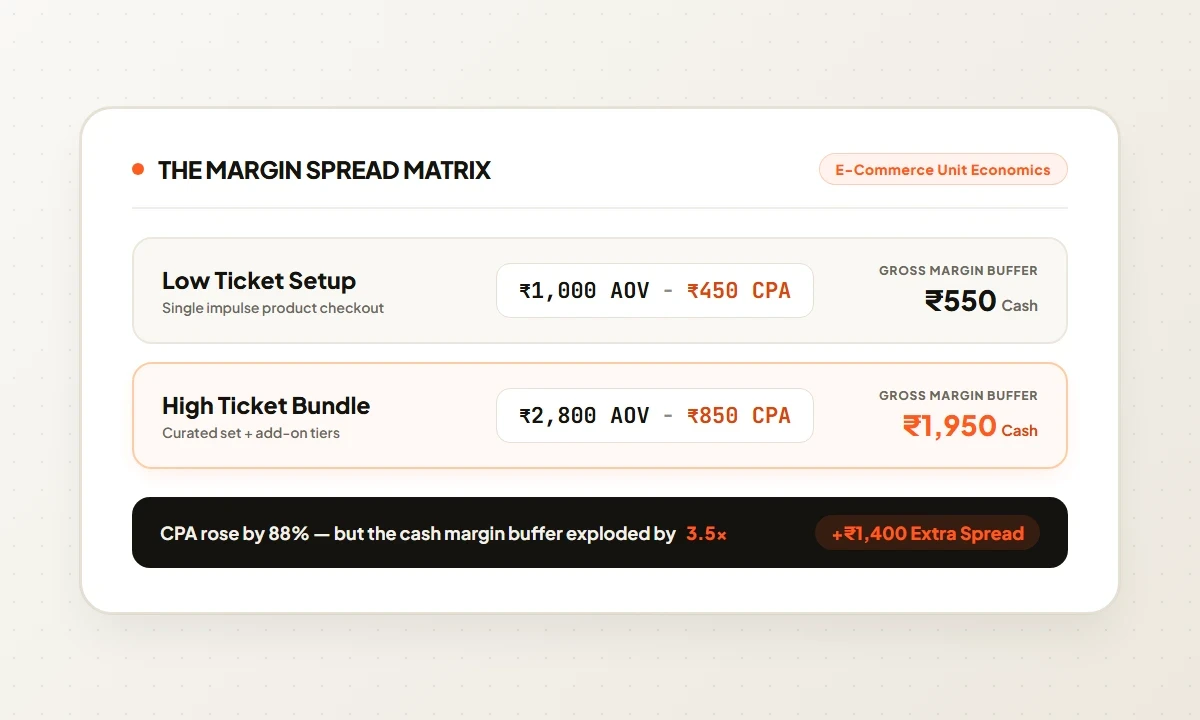
Even though your acquisition cost nearly doubled, your gross cash buffer tripled. That extra margin buffer allows you to outbid competitors, absorb shipping costs, and reinvest in scale.
Where in the Customer Journey Do You Actually Make Money?
Before touching your cart drawer or testing bundles, ask one foundational question: At which point in the customer journey do you intend to make your profit?
The Razor-Blade Model: You sell the handle at cost or break-even on order number one, because you know repeat blade purchases deliver predictable margin over twelve months.
The Single-Transaction Model: You sell a one-time purchase with low repeat frequency. You must make your profit on day one, inside the first checkout.
Knowing this changes your entire pricing strategy.
The Digital Upsell Angle: The Musical Instrument Lesson
A few months ago, I had a conversation with a founder in the D2C space who had previously angel-invested in brands like Palmonas.
He sells a patented physical product that helps people learn a musical instrument.
His unit economics were eye-opening: the front-end sale of the physical instrument was essentially break-even. Manufacturing, packaging, and paid ads consumed almost the entire initial ticket price.
Where was the actual profit made?
In the digital education layer. The real margin came from selling courses, coaching, and structured lessons teaching buyers how to master the instrument.
The Takeaway for Physical Brands:
If you sell a physical product, you don't always have to upsell another physical item that requires warehouse space, packaging, and courier charges.
Selling workout gear? Upsell an 8-week posture routine or training guide for ₹299.
Selling cookware? Upsell a digital chef masterclass for ₹399.
Selling skincare? Upsell a customized diet and gut-health protocol.
Digital upsells carry near-zero cost of goods sold (COGS). Every rupee goes straight toward widening your margin spread against your ad CPA.
Commodity vs. Unique: How Your Product Category Dictates AOV Strategy
Your product type dictates how aggressively you can structure your cart:
Unique / Proprietary Products: Pair the physical unit with education, software, or digital community access. Customers can't compare your price on Amazon, so your value proposition can anchor on transformation rather than product weight.
Commodity Products (Apparel, Basics, Skincare): Customers have price benchmarks. Your growth relies on volume bundling, curated sets, and post-purchase sequences.
Personal Case Study: How Raising Prices Lowered My Ad CPA
When I was selling t-shirts online, almost everything was flat-priced at ₹999.
As ad fatigue hit, my CPA on Meta climbed steadily, eating my net margins alive. Instead of discounting, I tested the exact opposite: I introduced tiered pricing and raised prices on premium cuts.
Baseline tees stayed at ₹999.
Heavyweight cotton and limited drops moved to ₹1,249 and ₹1,499.
High-end editions were priced at ₹1,999.
The Two Things That Happened:
Perceived Value Jumped: The store stopped looking like a clearance warehouse. Customers saw the ₹1,499 and ₹1,999 options and perceived the brand as deliberate and premium.
CPA Actually Dropped: Conversion rate on high-intent buyers improved because the product felt credible. The resulting higher Average Order Value gave the Meta auction more room to optimize, dropping our blended acquisition cost below its previous level.
Higher prices build certainty in the buyer's mind. When something looks too cheap, people wonder what defect they are paying for.
Moving Beyond Checkout: WhatsApp and Email Upselling
Increasing average order value shouldn't stop at the checkout button. Some of your highest-margin revenue happens 24 to 72 hours after the initial purchase.
1. The Post-Purchase WhatsApp Flow
Within 2 hours of placing an order, trigger an automated WhatsApp message while dopamine is still high:
"Hey [Name], your order for [Item] is being packed. Before we seal the box, would you like to add [Complementary Item] for an exclusive 25% off? Tap below to add it to your existing parcel with zero extra shipping fee."
Because the parcel hasn't shipped, combining items incurs zero additional courier overhead.
2. The Day-3 Email Education Loop
Send an onboarding email that transitions them into related consumables or advanced guides before their package even arrives. This lays the groundwork for order number two.
The AOV Optimization Checklist
Run this audit across your store:
The Spread Test: Are you tracking your net cash margin per order (AOV minus CPA and COGS), rather than just top-line ticket size?
The Profit Stage Defined: Do you know if your business makes money on transaction one or repeat order two?
Zero-COGS Add-ons: Have you tested a digital guide, video walkthrough, or priority dispatch in the cart?
The Price Variety Check: Do you offer at least three distinct price points on your catalog, or are you stuck at one flat number?
Post-Purchase Touchpoints: Are you using WhatsApp or email to offer parcel-combined add-ons before orders dispatch?