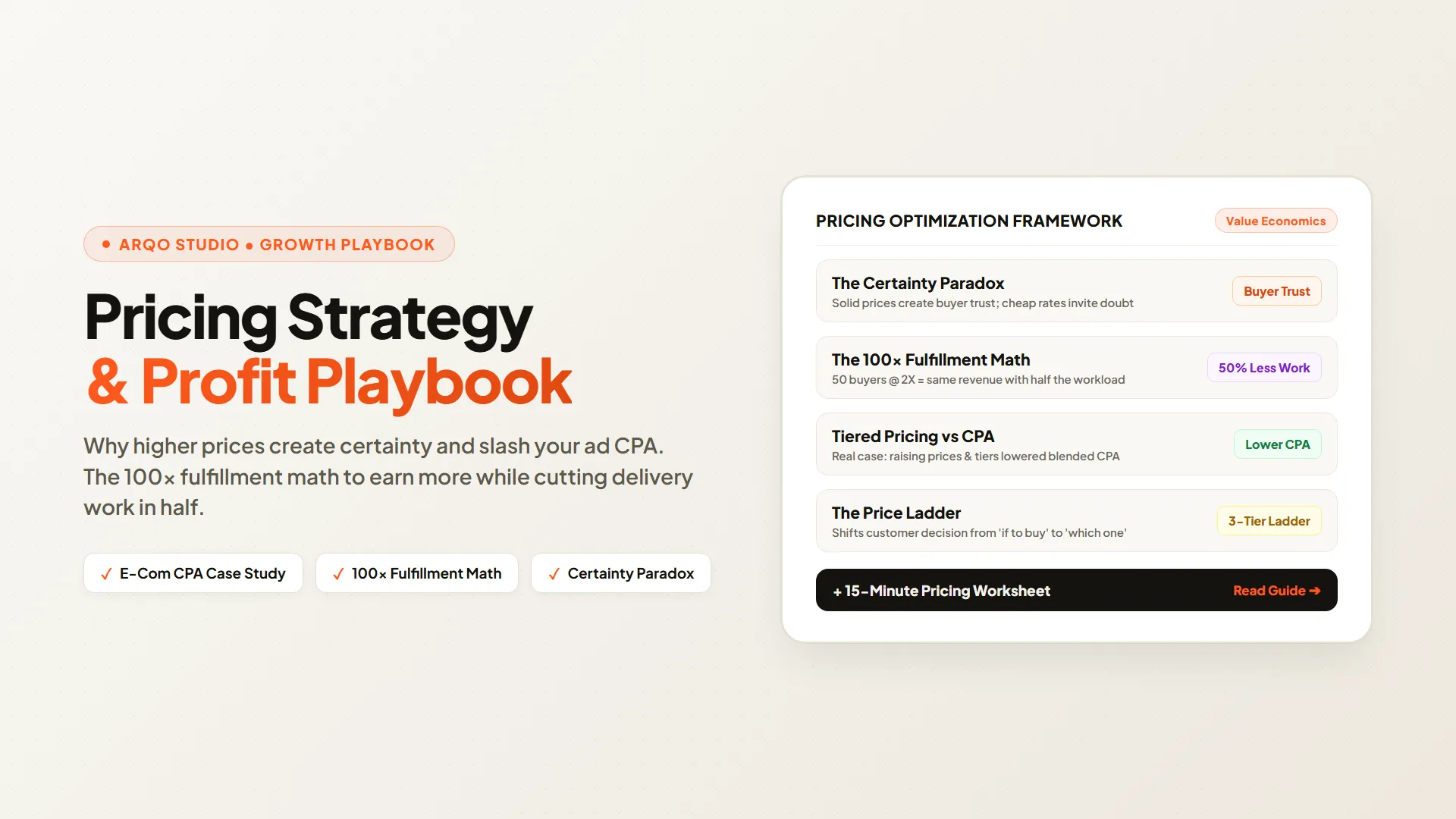
1. Why Cheap Pricing Destroys Both You and Your Customer
When I first started selling online, I did what almost every founder does: I checked what others were charging, shaved a little off to "stay competitive," and hoped volume would save me.
It didn't. It just made me busy, stressed, and broke.
Here is what happens when you underprice: you quietly force yourself into a compromise. When your margins are razor-thin, you can't afford better raw materials, you can't spend time giving clients personalized attention, and you can't hire great people. So quality inevitably drops.
When quality drops, customers get upset, complaints roll in, and your brand's reputation takes a hit.
A fair, higher price is actually the more honest price. It gives you the breathing room to deliver what you promised without cutting corners.
The Certainty Paradox
Price is not just a transaction number. Price is a trust signal.
When something is priced suspiciously low, buyers instinctively think: "What is wrong with this? What catch am I missing?"
A rock-bottom price creates doubt. A premium, deliberate price creates certainty. When a buyer sees a solid price tag, their brain assumes quality, competence, and reliability. By trying to look cheap to "remove friction," you often inject skepticism instead.
2. My E-Commerce Mistake: How Raising Prices Actually Dropped My CPA
Back when I was running an e-commerce brand selling graphic t-shirts, every single tee on the store was priced at ₹999.
After a few months, my ad performance started slipping. My Cost Per Acquisition (CPA) on Meta kept climbing, margins got eaten alive, and I thought I had an ad creative problem or a targeting problem.
I decided to run an experiment. Instead of discounting to salvage volume, I did the opposite: I raised prices and introduced tiered pricing.
I kept basic prints at ₹999.
I priced heavyweight fabrics and limited prints at ₹1,249 and ₹1,499.
I introduced premium editions at ₹1,999.
What Happened Next:
My CPA actually dropped below where it was before. It seemed backwards, but the higher price points completely changed the perception of the store. People stopped viewing it as a bargain bin and started seeing it as a curated brand.
High-intent buyers converted faster. The higher price weeded out window shoppers and attracted buyers who appreciated quality.
Price anchoring kicked in. Having a ₹1,999 tee made the ₹1,249 and ₹1,499 options feel completely reasonable. When everything was ₹999, customers had nothing to anchor value against.
The Meta auction rewarded us. Because our Average Order Value (AOV) went up, our revenue per visitor jumped. The ad algorithm had more margin and stronger purchase signals to optimize against.
If your ads are stalling, cutting your prices is usually the worst move you can make. Test price variations first.
3. The 100x Math: Halve Your Client List, Keep the Same Revenue
Let's look at the math that completely changed how I look at business operations.
Say you sell an offer at price X to 100 people. You make 100X.
Now price that same offer at 2X and sell to just 50 people. You still make 100X.
The revenue is identical. But look at what actually happens inside your business:
Metric | Selling at X (100 Clients) | Selling at 2X (50 Clients) |
|---|---|---|
Revenue | 100X | 100X |
Onboardings & Support | 100 people's worth of work | 50 people's worth of work |
Time Per Client | Rushed, constant firefighting | Room to do exceptional work |
Customer Friction | High (cheap buyers complain most) | Low (serious buyers focus on outcomes) |
Operational Stress | Overwhelming | Halved |
Quality Over Time | Pressure to cut corners | Quality is easily funded |
When you double your price and cut your volume in half, you don't lose anything. You buy back 50% of your time. And you can pour that reclaimed time back into making the product or service noticeably better for the 50 people who paid you.
4. Practical Rules for Setting Your Prices
If you want to build a sustainable pricing strategy, here are the core rules to live by:
1. Know Your True Cost Floor
Before you price anything, calculate what it actually costs you to deliver.
For products: Don't just count the manufacturing cost. Add packaging, shipping, payment gateway fees, platform fees, and an 8-10% allowance for returns and replacements.
For services: Count your delivery hours, team costs, software tools, plus a 20-30% buffer for revisions and scope creep.
2. Aim for Healthy Gross Margins
Gross margin is what keeps the lights on and pays for your customer acquisition.
D2C / Physical Products: Target 60% to 75% on landed cost (price at 3x to 4x of product cost).
Services & Agencies: Target 50% to 70% after delivery cost (price at 2x to 3x of labor cost).
Digital Products & Software: Target 80%+ gross margin.
3. Build a Price Ladder (Good / Better / Best)
When you offer only one price, the customer has to make a binary decision: "Yes or No?"
When you offer three tiers (Entry, Core, Premium), the question changes to: "Which one fits me best?"
Entry: Accessible, solves a specific piece of the problem.
Core: The main offer you want 60%+ of customers to choose.
Premium (Anchor): Priced at 1.5x to 2.5x the core offer. Even if only 10% buy it, it anchors the core offer and makes it look like an easy decision.
4. Stop Using .99 When Trust Matters
₹1,299 or ₹2,499 works for impulse buys and discount racks. But for high-ticket offers, consulting, and premium products, it looks like a marketer's trick. Clean numbers (₹1,250, ₹2,500, ₹50,000) feel deliberate, quiet, and confident.
5. Never Discount. Add Value Instead
When a prospect hesitates on price, never drop your fee. Discounting trains your audience to stall and negotiate. Instead, keep your price firm and adjust the deliverables: add an extra revision round, include a bonus setup, or reduce the scope to fit their budget.
5. How to Handle Price Objections on Live Calls
When someone tells you "It's too expensive," your reflex is usually to apologize, defend your numbers, or offer a 15% discount. Never do that.
Most of the time, "too expensive" is simply a knee-jerk reaction. Here is the exact framework to handle it with authority:
Step 1: The Comparison Check
Ask one simple question: "Compared to what?"
Nine times out of ten, they haven't compared you to anything specific. They're just reacting to the number. The moment you ask this, they have to articulate their logic out loud, and most realized they don't have a benchmark.
Step 2: The Iron Triangle (Fast, Cheap, Good)
Remind them of the universal law of business: You can only pick two.
If it's Fast and Cheap, it won't be Good.
If it's Cheap and Good, it won't be Fast.
If you want it Good and Fast, it cannot be Cheap.
Ask them directly: "Which of those three are you willing to sacrifice on this project?" This immediately reframes the conversation around tradeoff realities rather than arbitrary discounts.
Step 3: The "You Pay Either Way" Reframe
Help them realize that avoiding your fee doesn't save them money. They are going to pay the price either way:
They pay in money to have an expert build it right the first time.
Or they pay in wasted time trying to figure it out themselves over the next 12 months.
Or they pay in expensive mistakes, lost revenue, and burned ad spend hiring cheap freelancers who botch the execution.
Put it to them straight: "You're paying for this solution either way. Do you want to pay with cash to get it done now, or pay with your own time and trial-and-error over the next six months?"
Step 4: Resourcefulness vs. Resources (If They Truly Don't Have the Money)
Sometimes a prospect genuinely doesn't have the cash sitting in their bank account. But lack of resources is rarely the real bottleneck; lack of resourcefulness is.
The Emergency Reframe: If a loved one had an urgent medical emergency tomorrow that required this exact amount of money, they would find a way to arrange it within 24 hours. Why? Because the outcome is a non-negotiable priority. When someone says they "can't afford it," what they really mean is: "Solving this is not high enough on my priority list yet."
The "Everyone Starts at Zero" Truth: Every successful founder and self-made entrepreneur started with zero capital and zero connections. What separated them was not the resources they had in their pocket, but their willingness to be resourceful, back themselves, and find a way to invest in growth before they felt ready.
Step 5: Downsell the Scope (Never the Price)
If they are genuinely resourceful, understand the value, but have a hard cash constraint, you can offer a pathway forward without lowering your rates.
Never cut your price for the same deliverable. Instead, reduce the scope: "I can't lower the rate for this full system without compromising the outcome. But what we can do is strip out [Feature B and C] and start with a leaner phase-one build at your current budget."
Step 6: Be Completely Comfortable Walking Away
If they still push for cheap discounts or hesitate to commit, let them go: "Totally understand. It sounds like right now isn't the best time for us to partner, and that's completely fine. Keep following the free breakdowns, and we can always revisit this down the road when you're ready."
Walking away with posture protects your brand, preserves your authority, and keeps your calendar open for clients who respect your value.
Summary Checklist: Is Your Pricing Working?
Run your business through these 4 diagnostic checks:
The Margin Check: Are you making at least 50-65% gross margin after all fulfillment costs?
The Close Rate Check: If you are closing more than 75% of your sales conversations, your price is too low. Test an increase.
The Certainty Check: Does your price reflect the caliber of results you produce, or does it make buyers skeptical of your quality?
The 100x Check: Would your business be healthier and more profitable selling to half as many people at twice the rate?